Industrial Strategy – for Dual-Use and Defence Mineral Exploration in Canada
“Everything that Canada wants to build over the next decade begins beneath our feet, with someone finding something. Before any submarine, radar, satellite, munition or aircraft is manufactured, the metal must be discovered. This report is AME’s contribution to the Team Canada approach of bringing governments and industry together to protecting Canada’s sovereignty”
Todd Stone, President & CEO, Association for Mineral Exploration
Introduction
Canada’s defence and economic security begin long before a mine is built. They begin with exploration.
Canada has the geological potential, exploration expertise and allied credibility to make a meaningful contribution. But Canada’s current exploration market was not built to identify every mineral required for future defence and dual-use capability. Many strategically important minerals occur as co-products or byproducts in projects being advanced for copper, zinc, nickel, gold and other familiar commodities. They may not be routinely assayed, reported or incorporated into project planning.
AME’s industrial strategy sets out how Canada can close that gap.
Without exploration, there are no mines. Without mines, there is no supply chain to secure.
Executive Summary
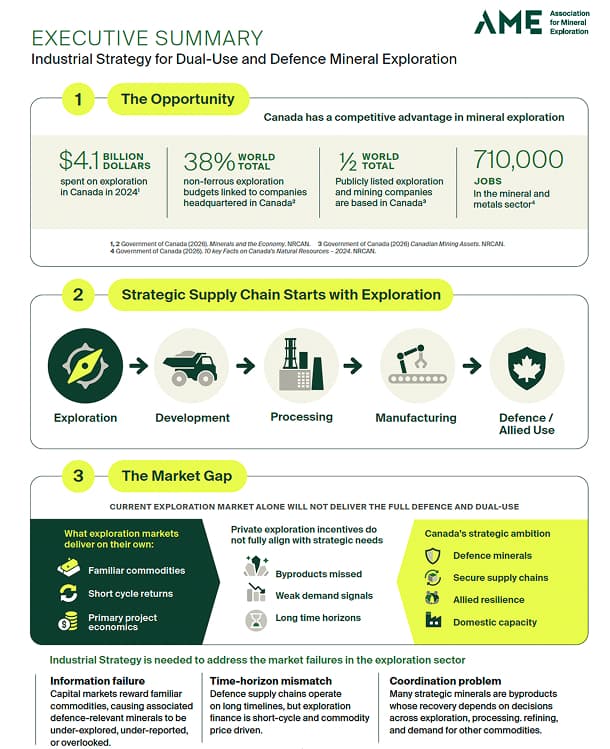
Canada’s exploration sector is strong, but current market incentives do not fully match Canada’s defence and dual-use needs. This paper sets out what closing that gap requires, through four pillars: Identify, Discover, De-risk and Connect.
Figure: Executive Summary
Market Failure
A market failure occurs when normal market incentives do not produce an outcome Canada needs. Markets are powerful, but they will under-invest when private returns do not reflect the wider public value of secure supply chains, national resilience and allied readiness.
Three Market Failures in the Mineral Exploration Space
The current exploration market is not designed to fully capture the public value of defence and dual-use minerals. Three market failures are especially important to the sector.
Information failure
Capital markets reward familiar commodities. That is rational, but it can mean explorers focus their programs on the metals that drive the project’s immediate economics and investor story.
Time-horizon Mismatch
Defence supply chains must be planned years before the materials are needed. Mineral exploration and mine development also take years, often more than a decade, from discovery to production.
Coordination Problem
Many defence-relevant minerals cannot be developed as standalone deposits. Their recovery may depend on decisions made across exploration, mining, processing, refining, manufacturing, procurement and stockpiling.
Policy Solution
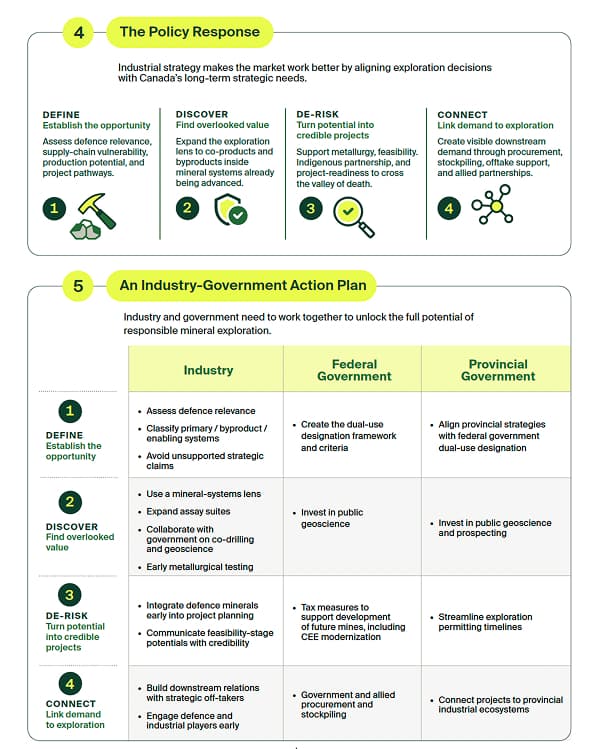
Four-Pillar industrial strategy: from mineral potential to allied supply-chain resilience.
The industrial strategy is organized around four practical pillars: Define, Discover, De-risk, and Connect. Together, these pillars provide a roadmap for junior explorers to recognize defence and dual-use relevant opportunities, adapt exploration practices, advance credible projects, and link upstream mineral potential to downstream industrial demand.
Pillar 1 – Define
Many minerals are important to defence and dual-use technologies, but not all are found or produced in the same way. Some can support standalone projects. Others occur as byproducts within copper, zinc, nickel, gold or polymetallic systems. A clear framework is needed to identify which minerals, mineral systems and recovery pathways matter most.
Pillar 2 – Discover
Many defence-relevant minerals occur alongside the copper, zinc, nickel, gold and other commodities Canada already explores, but they are not always assayed, reported or included in project planning. AME is calling for expanded assaying, byproduct mapping and public geoscience so Canada can identify strategic value already present in existing mineral systems, drill core and historical data.
Pillar 3 – De-risk
A discovery does not become a mine without the feasibility work, metallurgy, engineering, Indigenous partnership and project planning needed to move it forward. AME is calling to expand the Canadian Exploration Expense (CEE) eligibility so the work that turns a discovery into development is recognized and supported as the strategic investment it is.
Pillar 4 – Connect
Exploration capital follows credible demand, but explorers need clearer links to processors, manufacturers, defence users, procurement systems and allied supply chains. AME is calling for visible demand signals through procurement, stockpiling, offtake support and allied partnerships so strategic mineral projects can attract investment and move forward.
With targeted leadership, Canada can enable responsible exploration, and turn geological potential into long-term security, prosperity, and allied advantage.
Case Study
Nouveau Monde Graphite: Creating Demand Certainty
Location: Matawinie, QC
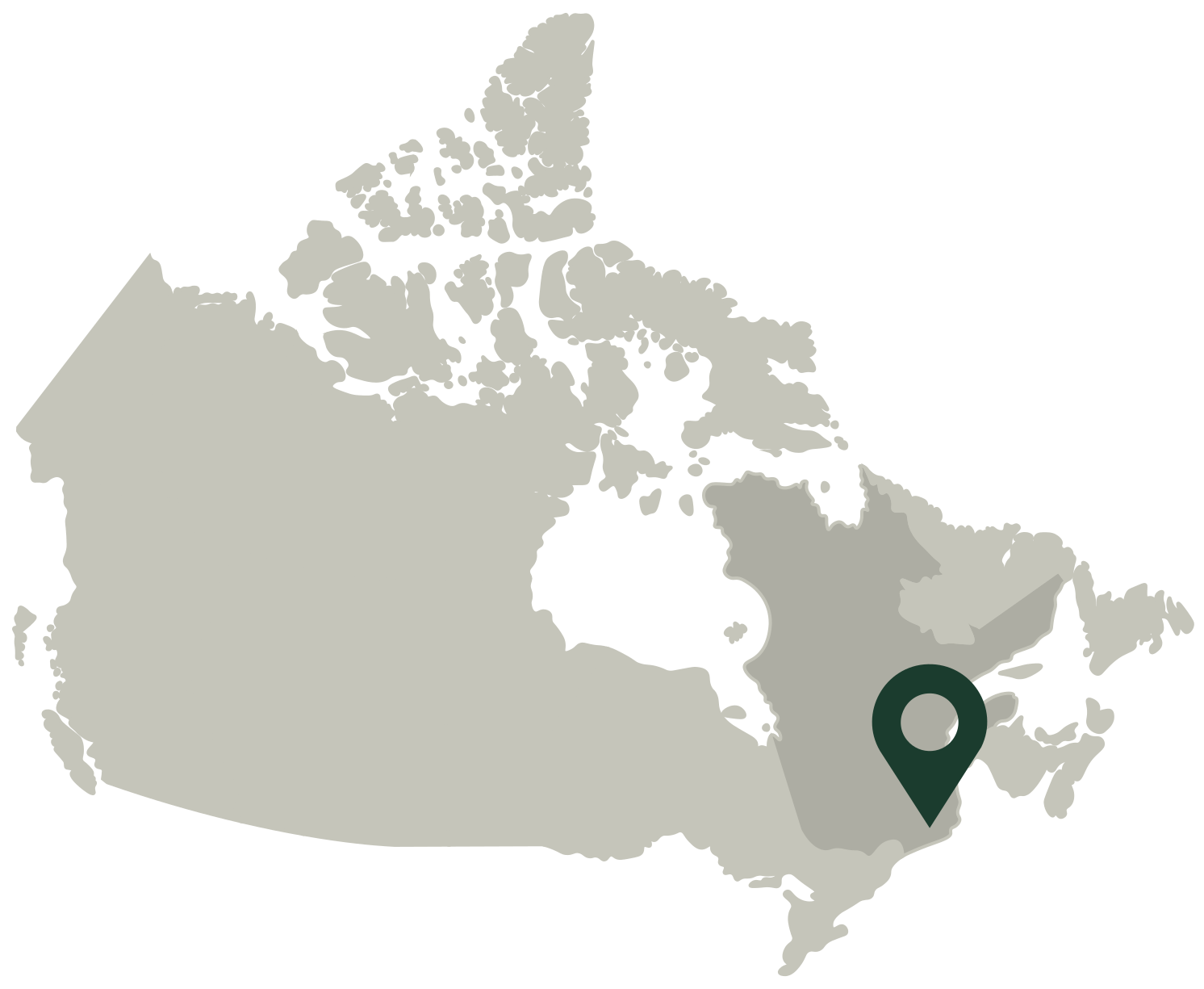
Nouveau Monde Graphite’s Matawinie project in Québec shows why connecting mineral projects to credible buyers matters. In 2026, the Government of Canada committed to purchase 30,000 tonnes of graphite concentrate annually for seven years on a take-or-pay basis, creating a predictable source of demand.
The project has also attracted an investment intention from the Government of Japan as part of broader G7 efforts to diversify critical-mineral supply chains. Canada has complemented the demand signal with approximately C$459 million in project debt from EDC and the Canada Infrastructure Bank, helping move Matawinie toward construction and production.
Graphite projects face a particular financing challenge because graphite products vary by grade, flake size and end-use specification, while battery customers require lengthy qualification. Without committed buyers, lenders face significant uncertainty over whether future production can actually be sold. Long-term offtakes reduce this risk by providing demand and pricing visibility, helping projects secure financing and reach construction.
The Lessons
Government and allied offtakes can help turn strategic demand into bankable projects by providing the market certainty needed to unlock financing and move mines toward construction
Why This Matters
“Canada is confident that our economic strategy and our many strategic resources—from critical minerals to cyber—will make major contributions to NATO rearmament.”
The Right Honourable Mark Carney June 9, 2025.
“Canada’s mineral sector is a strategic national asset. This strategy paper makes the important case that exploration is not peripheral to national security: it is the first phase in building the resource base that Canada and its allies may need to rely upon in a crisis.”
Heather Exner-Pirot Director, Natural Resources, Energy and Environment Macdonald-Laurier Institute
“Canada’s recurring challenge is translating strategic ambition into projects and productive investment. This report provides a useful framework for coordinating geological knowledge, capital, infrastructure and demand so that mineral security becomes an executable national strategy, consistent with Public Policy Forum’s Build Big Things work on investment attraction and its four-point policy frame for getting projects to FID.”
Jay Khosla, Executive VP Strategy and Policy, Public Policy Forum
“Canada’s mineral exploration sector is a major competitive and strategic advantage. As the world competes for secure access to critical minerals, there is no country better positioned than Canada to lead. This report makes a timely case for addressing market failures in mineral exploration and better aligning exploration with demand to strengthen our economic competitiveness and national security.”
Bryan Detchou, Senior Director, Natural Resources, Environment & Sustainability Canadian Chamber of Commerce
“Canada’s aerospace and defence manufacturing sector relies on highly specialized materials embedded throughout aircraft, engines, avionics, sensors and space systems. Building stronger connections across Canada’s industrial value chain — from exploration and processing through to advanced manufacturing and downstream users — can help strengthen supply chain resilience and ensure Canadian industry has secure and reliable access to the materials it depends on.”
Aerospace Industries Association of Canada
“Mining and manufacturing are deeply interconnected. Manufacturers need secure mineral supplies to produce critical goods, including defence equipment, while mining depends on manufacturers for the equipment and technology needed to develop those resources. This report highlights why strengthening Canada’s defence industrial base requires us to think about the entire supply chain, from exploration and extraction through to manufacturing.”
Alan Arcand, Chief Economist, Canadian Manufacturers & Exporters
“Critical minerals now sit at the intersection of economic security, national defence and geopolitical competition. Canada has extraordinary geological assets, but resources in the ground do not automatically translate into strategic advantage. This paper makes an important case for putting exploration at the heart of Canada’s critical minerals strategy and connecting it more deliberately to our defence, industrial and economic-security priorities. Doing so is not only a matter of resource development; it must also form an essential part of modern Canadian statecraft.”
Vina Nadjibulla, Co-Founder & CEO, Centre for Strategic Statecraft

Become a Member
AME champions a strong and responsible mineral exploration and development industry. Become a member to connect with the industry, support our work, and enjoy exclusive member benefits.